The German from Nick Ryan on Vimeo.
Monday, February 13, 2012
And Now For Something Completely Different...
Not related to PoWs in Manitoba, or Canada for that matter, but still a good video with an interesting twist!


Saturday, February 11, 2012
Some Updates on PoW Research
Today, I thought I would update everyone about some more research being done regarding PoWs in the province. A few weeks ago, I was made aware of another blogger, Linda, writing about one of the farming projects in Manitoba in 1945 and 1946. Having some records of these projects and eager to learn more, I got in contact with her. Linda has been very helpful in sharing what she knows about the project and has found some very interesting contacts. Her posts on the subject can be found on here blog, http://hutt-writevoice.blogspot.com. Her newest post also has some pictures of Robert Henderson's collection, which I can definitely say is the best collection of artifacts relating to PoWs and the Veterans Guard in the world!
It was also with Linda's help that I have become involved with another small project. She had been forwarded an email by an individual in Germany looking for information about his father. His father, a PoW captured in Normandy shortly after D-Day, was captured by the British and sent to Canada in the summer of 1944. Little was known about what happened next other than he spent some time in a labour camp in Manitoba near Lake Winnipeg or Manitoba. Looking through my collection of records, I was able to tell his son that his father was one of 130 PoWs that were employed by the Manitoba Paper Company outside of Mafeking, Manitoba. As I'm still working with him to identify more records and hopefully provide more information, I will keep you all updated!
It was also with Linda's help that I have become involved with another small project. She had been forwarded an email by an individual in Germany looking for information about his father. His father, a PoW captured in Normandy shortly after D-Day, was captured by the British and sent to Canada in the summer of 1944. Little was known about what happened next other than he spent some time in a labour camp in Manitoba near Lake Winnipeg or Manitoba. Looking through my collection of records, I was able to tell his son that his father was one of 130 PoWs that were employed by the Manitoba Paper Company outside of Mafeking, Manitoba. As I'm still working with him to identify more records and hopefully provide more information, I will keep you all updated!
Thursday, January 26, 2012
Leaving the Camp... Again...
Sixty-Eight Years Ago
First off, I would like to point out to all my viewers that there if you would like to receive email notification of new blog posts, please enter your email in the space to the right!
For those who are familiar with the stories from the camp in Riding Mountain National Park, you will certainly have heard how PoWs left the camp boundaries, visited dances, and became good friends with people on the park boundaries. Today, I'll give a brief explanation of how this came to be.
When the decision to build a camp in the park was first made in the summer of 1943, the issue of security was first and foremost to many. How to ensure that the PoWs remained with the camp boundaries and away from summer tourist traffic was something that the Parks Bureau especially focused on. It was eventually decided that the ten kilometers of Canadian wilderness surrounding the camp should be enough to keep wandering PoWs away from civilians. As such, trees were marked with red paint or flags to clearly mark the boundaries.
Despite the efforts taken by various departments and officials, they simply did not work. As I have already mentioned, only five days after arriving at the camp, nineteen PoWs had left the camp boundaries and had gotten lost. Other accounts of PoWs getting "lost" were fairly common and it seems like the warnings were simply ignored by a sizeable number of PoWs.
Among these PoWs was Konstatin Schwarz (or Schwartz). Using his days off at Christmas and New Years, he and some of his comrades decided to see what lay beyond the confines of the camp's borders. Following old logging trails, roads, and tracks, the PoWs found their way to places like the bison enclosure at Lake Audy and a firetower on the southern border of the park. It was this firetower that they were finally able to view the surrounding area. Much to their surprise, the area was primarily farmland.
It was upon viewing the farmhouses that the PoWs decided they needed to take a closer look...
First off, I would like to point out to all my viewers that there if you would like to receive email notification of new blog posts, please enter your email in the space to the right!
For those who are familiar with the stories from the camp in Riding Mountain National Park, you will certainly have heard how PoWs left the camp boundaries, visited dances, and became good friends with people on the park boundaries. Today, I'll give a brief explanation of how this came to be.
When the decision to build a camp in the park was first made in the summer of 1943, the issue of security was first and foremost to many. How to ensure that the PoWs remained with the camp boundaries and away from summer tourist traffic was something that the Parks Bureau especially focused on. It was eventually decided that the ten kilometers of Canadian wilderness surrounding the camp should be enough to keep wandering PoWs away from civilians. As such, trees were marked with red paint or flags to clearly mark the boundaries.
Despite the efforts taken by various departments and officials, they simply did not work. As I have already mentioned, only five days after arriving at the camp, nineteen PoWs had left the camp boundaries and had gotten lost. Other accounts of PoWs getting "lost" were fairly common and it seems like the warnings were simply ignored by a sizeable number of PoWs.
Among these PoWs was Konstatin Schwarz (or Schwartz). Using his days off at Christmas and New Years, he and some of his comrades decided to see what lay beyond the confines of the camp's borders. Following old logging trails, roads, and tracks, the PoWs found their way to places like the bison enclosure at Lake Audy and a firetower on the southern border of the park. It was this firetower that they were finally able to view the surrounding area. Much to their surprise, the area was primarily farmland.
It was upon viewing the farmhouses that the PoWs decided they needed to take a closer look...
Thursday, January 19, 2012
Home Again!
Having returned home from Ottawa this week I can certainly say that the trip was a success! Having spent a little over a week there, Adrian and I sorted through thousands of documents relating to PoWs in Canada. In the end, we took almost 15,000 pictures of documents ranging from pay lists from labour projects in Manitoba to escape reports to orders written by Riding Mountain's camp administrator! Spending between eight and ten hours at the archives made for some very long days but in the end, we just had enough time to document everything we wanted to. However, I am sure another trip is in order in the next year or two!
While in Ottawa, we couldn't miss going to the Canadian War Museum which has an absolutely amazing collection of artifacts ranging from Canada's first settlers to the modern day. We had requested to see some of their holdings relating to PoWs in Canada beforehand so we were given special access to articles like PoW work jackets, German uniforms and equipment, as well as Canadian uniforms. After this we were given a behind-the-scene tour of the museum's facilities which was absolutely amazing! To see items like the uniforms of Billy Bishop and Sir Arthur Currie, General Wolfe's chair, and Hitler's telephone up close was something I will never forget! A big thanks goes out to the museum staff!
On a side note, German PoWs in Canada wore a wide range of clothing depending on where they were located within the country and the work they were involved in. For formal wear and while in larger internment camps, PoWs were authorized to wear German uniforms, complete with their insignia, rank, and medals. However, for those participating in labour projects, each PoW was issued a specially-marked set of clothing that included a jacket, pair of trousers, and a cap. To identify these men as PoWs, the jacket had a large circle on the reverse (which the PoWs often joked was a target for the guards to aim at in case they attempted escape, while the trousers and hat had a red stripe sewn down the length. Having seen some examples of this clothing before, it was still great to see these items up close.
Anyways, I will certainly busy for the next few months as I work my way through all of the files!
 |
| PoW Work Jacket with "target" - Canadian War Museum |
On a side note, German PoWs in Canada wore a wide range of clothing depending on where they were located within the country and the work they were involved in. For formal wear and while in larger internment camps, PoWs were authorized to wear German uniforms, complete with their insignia, rank, and medals. However, for those participating in labour projects, each PoW was issued a specially-marked set of clothing that included a jacket, pair of trousers, and a cap. To identify these men as PoWs, the jacket had a large circle on the reverse (which the PoWs often joked was a target for the guards to aim at in case they attempted escape, while the trousers and hat had a red stripe sewn down the length. Having seen some examples of this clothing before, it was still great to see these items up close.
Anyways, I will certainly busy for the next few months as I work my way through all of the files!
Friday, January 13, 2012
Better Late than Never!
First off, I must apologize for my very late update! Things seem to have gotten very busy over the holidays and I wasn't able to update it.
Anyways, as for my last post, I left a question unanswered. For those who were wondering what the answer may be, a small number of the harassed PoWs at Riding Mountain had served in the French Foreign Legion in the late 1920s and 1930s. Despite having returned to Germany before 1933, these men were continually monitored by the Gestapo and were unable to find jobs. During the war, these men were placed in the 361st Regiment and were often found in harm's way. As such, a large number of the 361st were taken prisoner and sent to Canada.
For the rest of today's post, I would like to update everyone on some of what I have been doing in regards to PoWs in Manitoba. Since Monday, myself and archaeologist Adrian Myers have been in Ottawa visiting the Library and Archives Canada. With the largest collection of PoW related material in the country, the LAC has been on my to-do list for some years! In the past few days, we've copied over 10,000 documents which have helped answered a lot of questions and filled in quite a few gaps in my records. This will certainly keep me busy for a while!
Check back in the next few days for another update!
Anyways, as for my last post, I left a question unanswered. For those who were wondering what the answer may be, a small number of the harassed PoWs at Riding Mountain had served in the French Foreign Legion in the late 1920s and 1930s. Despite having returned to Germany before 1933, these men were continually monitored by the Gestapo and were unable to find jobs. During the war, these men were placed in the 361st Regiment and were often found in harm's way. As such, a large number of the 361st were taken prisoner and sent to Canada.
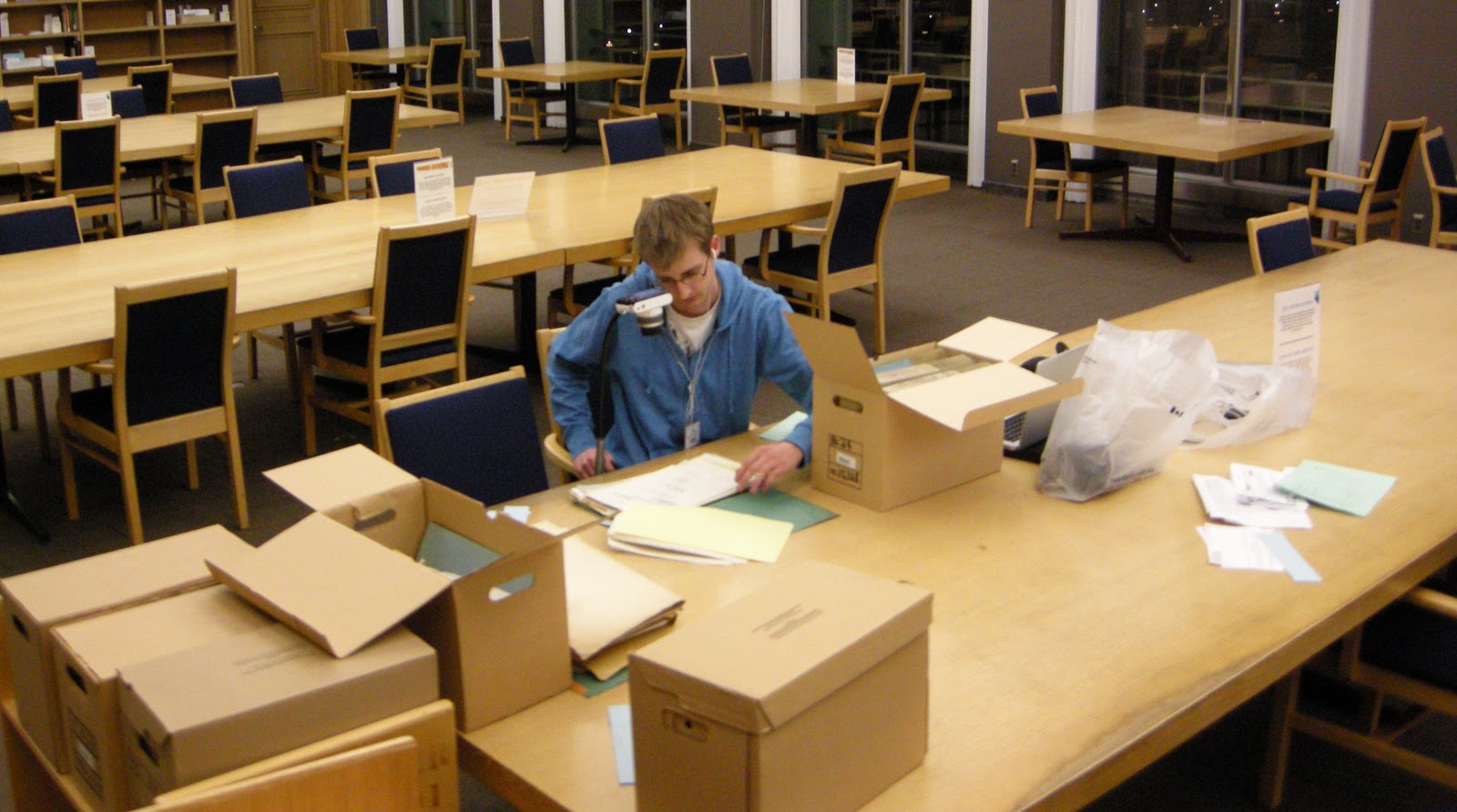 |
| Hard at Work! |
Check back in the next few days for another update!
Wednesday, December 21, 2011
Dissidents in the Camp
Today - 68 Years Ago
Before beginning this post, I'm going to clarify a point that has been brought up in presentations that I've given in the past about the camp. Since the end of the war, German soldiers have often been grouped together and labelled as "Nazis" but this was not the case. Technically a Nazi was a member of the Nazi Party, Hitler's political party that rose to power in the 1930s, and included thousands of German soldiers and citizens. However, one did not have to be a Nazi to be in the Germany Army. Like many armies in World War II, the German military brought countless numbers of German men who were certainly not members of the Nazi party as well as those who considered themselves anti-Nazis. It is these men I'd like to talk about briefly.
Only two months after their arrival in Riding Mountain National Park, a clear group of hardcore Nazi prisoners has established themselves in the camp. Like many camps in Canada, these pro-Nazis took it upon themselves to ensure that the Nazi ideals were present in all internment and labour camps and were willing to go to great lengths to do so. Punishment for those who spoke out against the Nazi Party, the German War effort, or Hitler was often brutal and swift. At least two prisoners who spoke out against Hitler and the war were murdered in Medicine Hat and while no murders were commited at Riding Mountain, my records indicate this was certainly an option that the Nazis in the camp had considered.
On December 15, 1943, four PoWs, each of whom were against the war, decided they had had enough. Two prisoners, Fritz Dornseif and Otto Ecker left the camp at 8:30 pm and gave themselves up to the guards at the camp entrance, asking for protective custody. Two others, Paul Nowack and Peter Fergen, left the camp boundaries and were found by farmers the next morning.
With the four prisoners back at the camp, each stated that had been "mentally tormented" to such a degree that they felt their lives were in danger. For them, leaving the camp was the only answer. The four had one thing in common and this lay with the careers they had chosen in the inter-war years...
Anyone have any idea what this may be? Post a comment if you do! I'll give the answer in the next day or two.
Before beginning this post, I'm going to clarify a point that has been brought up in presentations that I've given in the past about the camp. Since the end of the war, German soldiers have often been grouped together and labelled as "Nazis" but this was not the case. Technically a Nazi was a member of the Nazi Party, Hitler's political party that rose to power in the 1930s, and included thousands of German soldiers and citizens. However, one did not have to be a Nazi to be in the Germany Army. Like many armies in World War II, the German military brought countless numbers of German men who were certainly not members of the Nazi party as well as those who considered themselves anti-Nazis. It is these men I'd like to talk about briefly.
Only two months after their arrival in Riding Mountain National Park, a clear group of hardcore Nazi prisoners has established themselves in the camp. Like many camps in Canada, these pro-Nazis took it upon themselves to ensure that the Nazi ideals were present in all internment and labour camps and were willing to go to great lengths to do so. Punishment for those who spoke out against the Nazi Party, the German War effort, or Hitler was often brutal and swift. At least two prisoners who spoke out against Hitler and the war were murdered in Medicine Hat and while no murders were commited at Riding Mountain, my records indicate this was certainly an option that the Nazis in the camp had considered.
On December 15, 1943, four PoWs, each of whom were against the war, decided they had had enough. Two prisoners, Fritz Dornseif and Otto Ecker left the camp at 8:30 pm and gave themselves up to the guards at the camp entrance, asking for protective custody. Two others, Paul Nowack and Peter Fergen, left the camp boundaries and were found by farmers the next morning.
With the four prisoners back at the camp, each stated that had been "mentally tormented" to such a degree that they felt their lives were in danger. For them, leaving the camp was the only answer. The four had one thing in common and this lay with the careers they had chosen in the inter-war years...
Anyone have any idea what this may be? Post a comment if you do! I'll give the answer in the next day or two.
Monday, December 5, 2011
Changing the Guard
This Week - 68 Years Ago
The first week of December 1943 marked the first official change in the Veterans Guard detachment stationed at the camp. The Veterans Guard of Canada, which I mentioned here, was the official military guard compliment that supported a Civilian Guard force. Each Veterans Guard company spent only a few months at a PoW camp to prevent the guards and PoWs from getting to familiar with one another and Riding Mountain Park Project was no exception.
The first Veterans Guard compliment at Riding Mountain were among those that escorted the PoWs to Dauphin and were selected to stay. Commanded by Lt. Shewfeld, these men spent a little over a month at Riding Mountain before being replaced.
The new guards were members of a platoon of No. 23 Company, Veterans Guard of Canada. No. 23 Compnay was one of two Active Service companies formed in Manitoba, with No. 22 based out of Winnipeg and No. 23 out of Brandon. About twenty-five men were selected for guard duty at Riding Mountain and the majority of these men were locals from communities like Clanwilliam, Neepawa, Brandon, and Minnedosa. One can imagine that they must have been happy to be stationed so close to home.
The officer in charge, Lt. Colin "Scotty" Mann of Neepawa had enlisted shortly after war broke out in 1939. He and his men had already served in various internment camps including those at Gravehurst (Ontario), Medicine Hat, and Lethbridge and were well experienced in guarding PoWs.
Despite three or four years experience, the PoWs at Riding Mountain would soon put these men to the test...
The first week of December 1943 marked the first official change in the Veterans Guard detachment stationed at the camp. The Veterans Guard of Canada, which I mentioned here, was the official military guard compliment that supported a Civilian Guard force. Each Veterans Guard company spent only a few months at a PoW camp to prevent the guards and PoWs from getting to familiar with one another and Riding Mountain Park Project was no exception.
The first Veterans Guard compliment at Riding Mountain were among those that escorted the PoWs to Dauphin and were selected to stay. Commanded by Lt. Shewfeld, these men spent a little over a month at Riding Mountain before being replaced.
The new guards were members of a platoon of No. 23 Company, Veterans Guard of Canada. No. 23 Compnay was one of two Active Service companies formed in Manitoba, with No. 22 based out of Winnipeg and No. 23 out of Brandon. About twenty-five men were selected for guard duty at Riding Mountain and the majority of these men were locals from communities like Clanwilliam, Neepawa, Brandon, and Minnedosa. One can imagine that they must have been happy to be stationed so close to home.
 |
| Lt. Mann (crouching in the front row, far left) and his platoon of the No. 23 Coy. VGC during training at Port Arthur, Ontario |
The officer in charge, Lt. Colin "Scotty" Mann of Neepawa had enlisted shortly after war broke out in 1939. He and his men had already served in various internment camps including those at Gravehurst (Ontario), Medicine Hat, and Lethbridge and were well experienced in guarding PoWs.
Despite three or four years experience, the PoWs at Riding Mountain would soon put these men to the test...
Subscribe to:
Posts (Atom)